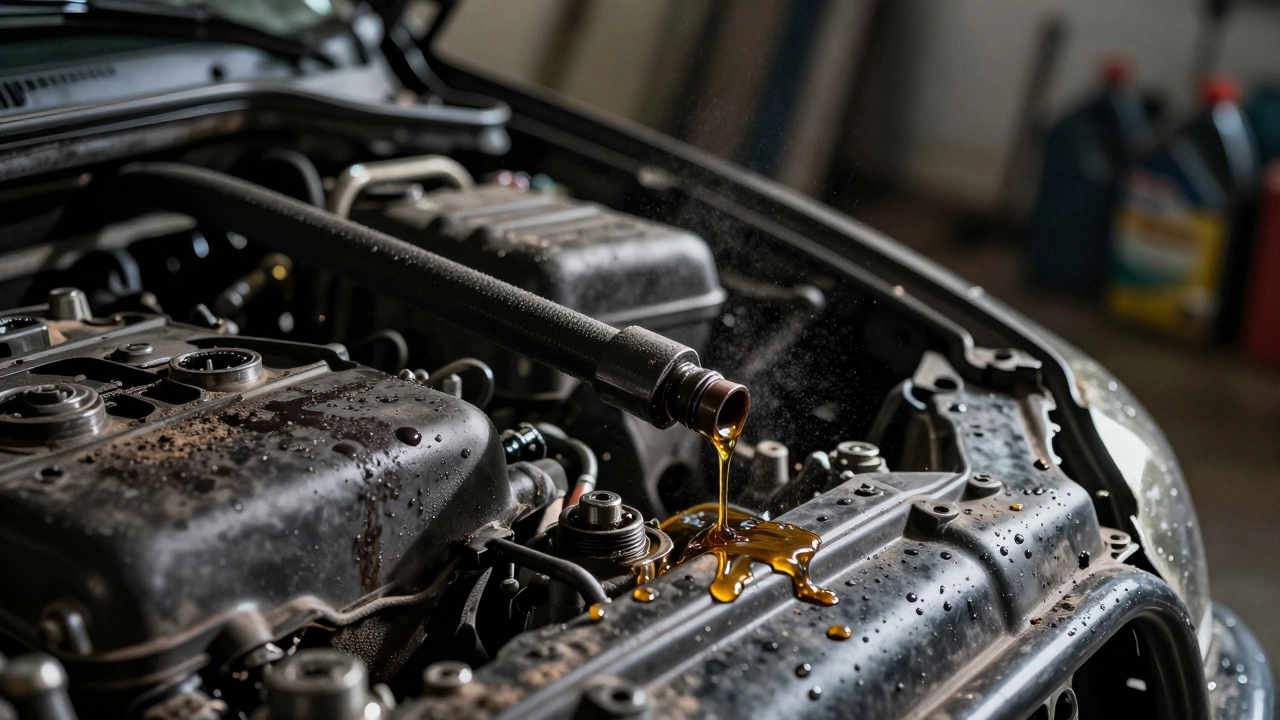
Most car manuals say to change your oil every 10,000 to 15,000 kilometers, but if you’re driving mostly short trips in stop-and-go traffic, that number might be a lie. You could be damaging your engine without even knowing it. The truth is, oil change intervals aren’t one-size-fits-all. They depend on how you drive, what kind of oil you use, and even the weather where you live.
What happens when you skip an oil change?
Engine oil doesn’t just lubricate-it cools, cleans, and protects. Over time, it breaks down. Heat from the engine turns fresh oil into sludge. Dust and metal particles from normal wear mix in. Add moisture from short trips that never let the engine fully warm up, and you’ve got a recipe for corrosion.
After 20,000 kilometers without a change, the oil’s additives are mostly gone. The viscosity drops. It doesn’t cling to engine parts like it should. Bearings, camshafts, and piston rings start to grind. You won’t feel it right away. No warning lights. No strange noises. But inside the engine, tiny scratches are building up. Eventually, you’ll see reduced fuel economy, higher emissions, or worse-a seized engine.
In Auckland’s damp climate, condensation builds up faster. If you drive to work, run errands, and park the car, the engine never reaches full operating temperature. That means water doesn’t evaporate. It sits in the oil. Over months, that water turns into acid. Acid eats metal. And once it starts, you can’t reverse it.
How long is too long? The hard limits
There’s no magic number, but here’s what happens at key milestones:
- 10,000 km: This is the manufacturer’s recommended interval for most new cars using full synthetic oil. Fine if you drive mostly highway miles.
- 15,000 km: The absolute max for synthetic oil under ideal conditions. Only safe if you drive 80% highway, in dry weather, and never tow or carry heavy loads.
- 20,000 km: You’re in danger territory. Oil has lost 70% of its protective properties. Sludge is forming. Risk of engine damage jumps sharply.
- 25,000 km+: This isn’t just overdue-it’s reckless. Many engines fail around this point. The cost of repair? $5,000 or more. A simple oil change? $60.
Here’s the kicker: if you’re using conventional oil (not synthetic), you shouldn’t go past 7,500 km. Most people don’t realize their car doesn’t need synthetic oil. If your manual says "synthetic blend" or "conventional," don’t stretch it.
Driving habits matter more than mileage
Two people can drive the same car, same oil, same mileage-but one keeps their engine healthy, the other doesn’t. Why? Driving patterns.
If you:
- Take trips under 8 kilometers often (like commuting or school runs)
- Drive in heavy traffic with frequent stops
- Tow trailers or carry heavy loads
- Live in extreme heat or cold
- Use your car for ride-sharing or delivery work
Then you’re in severe service mode. That means you need oil changes every 5,000 to 7,500 km-even if your manual says 15,000.
Real example: A taxi driver in West Auckland changed oil every 8,000 km. His car had 280,000 km on it with zero engine issues. A neighbor with the same model drove 12,000 km a year but only on short trips. He skipped oil changes for 22,000 km. His engine blew at 140,000 km. Same car. Same oil. Different habits.

How to know if your oil is still good
You can’t tell by color alone. Old oil is dark. New oil can be dark too, depending on the brand. Here’s what actually works:
- Check the dipstick monthly. Look for thick, gritty texture. If it feels like sandpaper between your fingers, it’s done.
- Smell it. If it smells burnt or like burnt toast, the oil has overheated and lost its protective qualities.
- Watch for warning signs: louder engine noise, rough idle, or the check engine light coming on with codes like P0011 or P0016 (timing issues from poor lubrication).
- Use an oil analysis kit. For $30, you can send a sample to a lab. They test viscosity, contamination, and additive levels. It’s the only way to know for sure.
Most mechanics won’t offer this, but it’s worth it if you’re trying to stretch intervals. One customer in Manukau did this every 10,000 km. Turned out his synthetic oil was still at 85% effectiveness at 18,000 km. He saved two changes that year.
What type of oil should you use?
Not all oils are created equal. Here’s what works best in New Zealand conditions:
| Type | Typical Interval | Best For | Downsides |
|---|---|---|---|
| Conventional (mineral) | 5,000-7,500 km | Older cars, low-mileage drivers | Breaks down fast in heat, not good for turbo engines |
| Synthetic Blend | 7,500-10,000 km | Most modern cars, mixed driving | Still contains some conventional oil-less protection than full synthetic |
| Full Synthetic | 10,000-15,000 km | High-performance, turbocharged, or cold-climate driving | More expensive upfront, but lasts longer and protects better |
| High-Mileage | 7,500-10,000 km | Cars over 100,000 km with leaks or oil consumption | Contains seal conditioners, not needed for newer engines |
If your car is under 10 years old and uses full synthetic, stick with it. Don’t downgrade to conventional to save money. You’ll pay more in repairs later.
What about oil life monitors?
Most cars built after 2015 have an oil life monitor. It tracks engine temperature, RPM, driving time, and load to estimate oil condition. It’s usually accurate-if you keep it reset properly.
But here’s the trap: people reset it after every oil change, but forget to reset it if they change the oil themselves. The system then keeps counting from zero, telling you you’ve got 80% life left when you’re already overdue.
Always reset the oil life monitor after every change. If you don’t know how, check your manual. Most cars require holding a button on the dashboard while turning the ignition.
Still, don’t trust it blindly. If you drive mostly short trips, cut the monitor’s estimate in half. It’s designed for highway driving, not Auckland’s urban crawl.

When to change your oil: a simple rule
Here’s the easiest way to decide:
- If you drive mostly highway miles, over 15,000 km a year, and use full synthetic → change every 15,000 km.
- If you drive mostly city, under 10,000 km a year, or do short trips → change every 7,500 km.
- If you’re unsure, change every 10,000 km. It’s the safe middle ground.
And if you’re still not sure? Change it every 6 months. Time matters as much as mileage. Oil degrades even if the car sits.
What about electric cars?
Electric vehicles don’t need oil changes. But if you drive a hybrid, you still do. The gasoline engine runs just like any other car. Some hybrids have oil life monitors that don’t account for the electric motor’s idle time. So even if the system says you’re fine, check the oil manually every 6 months.
Toyota Prius owners in Auckland who skipped oil changes for 25,000 km reported engine knocking. Toyota’s warranty didn’t cover it because the manual said 15,000 km. The owner didn’t realize hybrids still need oil.
Can I just top up my oil instead of changing it?
No. Topping up adds fresh oil to dirty oil. It doesn’t remove sludge, metal particles, or water. You’re diluting contamination, not fixing it. Over time, the oil becomes a thick, dirty slurry that can’t protect your engine. Always drain and replace-never just add.
Is it okay to change oil every 20,000 km if I use synthetic?
Only if you drive 90% highway, in dry weather, and never tow or carry heavy loads. Even then, you’re pushing it. Most engines start showing wear after 18,000 km. The risk of sludge buildup, bearing wear, or timing chain issues increases significantly. It’s not worth the gamble.
Does the type of oil filter matter?
Yes. A cheap filter can clog faster, letting dirty oil bypass into the engine. Use a filter made for your engine type. For example, if your car uses a 10-micron filter, don’t swap it for a 25-micron one. The wrong filter can cause premature wear. Stick to OEM or trusted brands like Mann-Filter, Mahle, or Bosch.
What if I forget and go 3,000 km over my interval?
Don’t panic. One or two thousand kilometers over isn’t a disaster. But don’t make it a habit. Get it changed as soon as possible. If you’re more than 5,000 km overdue, have the oil drained and the engine inspected for sludge. A simple flush might be needed.
Can I use synthetic oil in an older car?
Yes, but only if the engine is in good condition. Synthetic oil cleans more aggressively. In engines with worn seals or deposits, it can cause leaks by removing built-up gunk that was acting as a seal. If your car is over 150,000 km and has minor leaks, stick with high-mileage oil. If it’s clean and tight, synthetic is better.
Final advice: Don’t wait for the warning
Modern engines are built to last, but they’re not indestructible. Skipping oil changes is like skipping dental checkups-you won’t feel pain until it’s too late. The best time to change your oil isn’t when the light comes on. It’s before you even think about it.
Set a reminder on your phone every 6 months. Or better yet, change it every winter and every summer. That way, you never forget. It’s a small cost for peace of mind-and a long-lasting engine.








Write a comment