Spark Plug Replacement Cost Calculator
Based on your inputs:
Time until remaining plugs fail:
Total cost if waiting:
Actual savings:
Ever heard someone say, "Just replace the bad ones" when it comes to spark plugs? It sounds smart-why spend money on all eight if only two are fouled? But here’s the truth: changing only some spark plugs is a gamble that often costs more in the long run. Most mechanics won’t even recommend it. And here’s why.
Why Spark Plugs Work as a Team
Your engine doesn’t run on one spark plug. It runs on all of them firing in perfect sync. Each plug has to ignite the air-fuel mixture at the exact same moment, every single time. If one plug is weaker, older, or fouled, it throws off the rhythm. Think of it like a rowing team: if one person is out of sync, the whole boat slows down-even if the others are strong.Modern engines are tuned for balance. The ECU (engine control unit) expects every cylinder to perform the same. When one plug starts misfiring, the computer tries to compensate by adjusting fuel and timing. That puts extra stress on the good plugs, the fuel injectors, and even the catalytic converter. Over time, this imbalance can cause more damage than the original worn plug ever did.
What Happens When You Replace Only Some
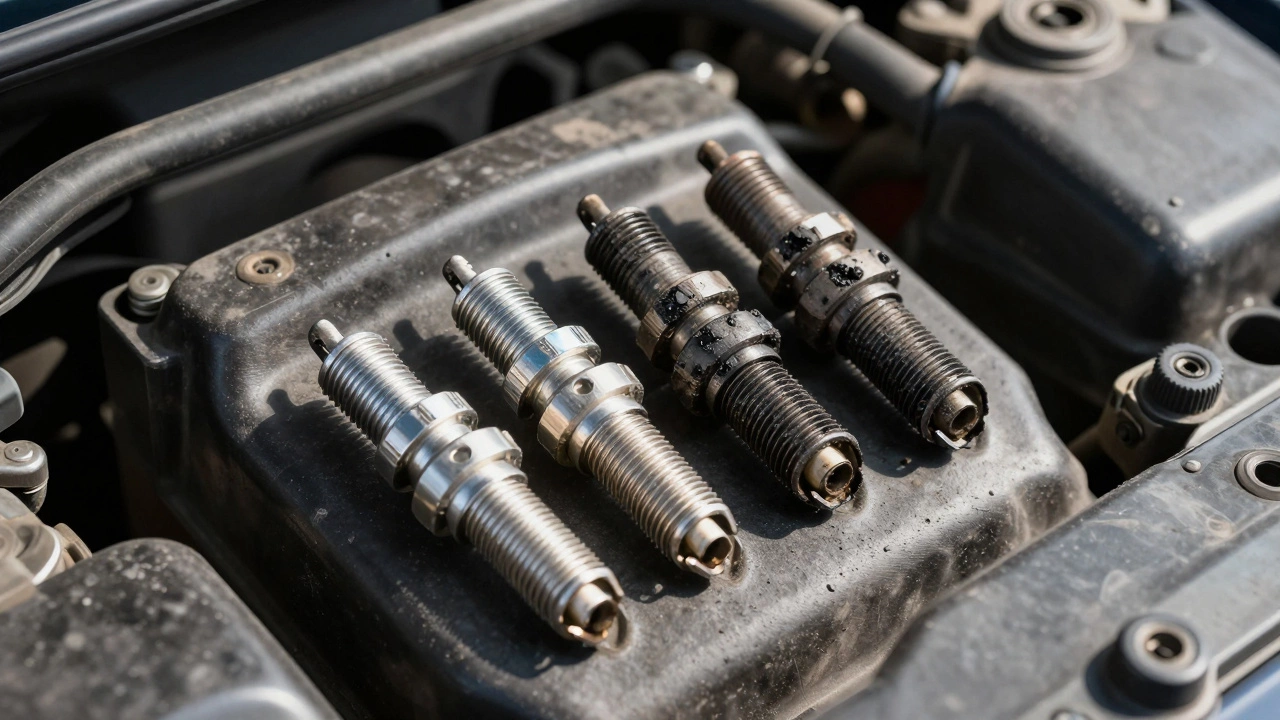
Let’s say you have a four-cylinder engine. Two plugs are old, gunked up, and misfiring. You pull those two, replace them, and leave the other two alone. They’ve got 80,000 miles on them. Sounds fine, right?Wrong.
The new plugs will fire hotter and more efficiently. The old ones? They’re sluggish. The result? A noticeable difference in power delivery. You’ll feel it in the throttle response. You might notice a rough idle, especially when the car is cold. Some drivers report a slight hesitation during acceleration-like the engine is catching its breath.
And here’s the sneaky part: the old plugs are already worn. Their electrodes are eroded. Their gap has widened. They’re not just old-they’re close to failing. In a few thousand kilometers, they’ll start misfiring too. Now you’re back to replacing them. But this time, you’ve already paid for two new ones. You’ve doubled your labor cost, and you’ve driven on uneven performance the whole time.
Cost vs. Risk: The Real Math
Let’s break it down with real numbers. In New Zealand, a full set of spark plugs for a typical family sedan (like a Toyota Corolla or Honda Civic) costs between $60 and $120. Labor? Around $80 to $150, depending on the engine layout. Some cars make it easy-others, like boxer engines or V6s tucked deep under the manifold, can run you $200 in labor.If you replace only two plugs, you’re still paying most of that labor cost. You’re spending $30-$60 on two new plugs, and $100 in labor. Total: $130-$160.
If you replace all four? You spend $120 on plugs and $150 labor. Total: $270.
Looks like you saved $110 by doing half. But wait-you’re going to need to do the other two in 15,000 to 20,000 km. So now you’re paying labor again. That’s another $150. Total spent: $310. You didn’t save anything. You just delayed the inevitable.
And that’s not even counting the hidden costs: reduced fuel economy, increased emissions, potential damage to the catalytic converter, or even a failed emissions test. In Auckland, emissions inspections are strict. A misfiring cylinder can trigger a fail.

What About High-End Engines?
Some luxury or performance cars use iridium or platinum plugs that last 160,000 km or more. Even then, replacing only some is a bad idea.These engines are finely tuned. The difference between a 140,000 km plug and a 10,000 km plug is tiny-but it’s enough. In a turbocharged engine, even a 0.02mm difference in gap size can cause detonation or lean conditions. That’s not just a performance hit-it can lead to piston damage. One bad plug in a high-compression engine can cost you thousands.
Manufacturers don’t recommend partial replacements for a reason. Your owner’s manual says to replace all spark plugs at the interval. That’s not a suggestion. It’s a safety and performance requirement.
When Is It Acceptable to Replace Just One?
There’s one real exception: if one plug fails catastrophically while you’re on the road. Say, you’re driving, the engine suddenly misfires badly, and you pull over. You check the plugs and one is cracked, broken, or soaked in oil.In that emergency, you can replace just that one plug to get home. But here’s the rule: as soon as you get home, replace the entire set. Don’t wait. Don’t delay. That single plug didn’t fail alone. The others are close behind.
Same goes for engines with very hard-to-reach plugs. If you’re replacing one plug on a V8 and it takes six hours to get to it, you still need to replace them all. The labor cost is already sky-high. Why not do it right the first time?

Signs You Need a Full Replacement
You don’t need a diagnostic tool to know your spark plugs are overdue. Here’s what to look for:- Engine misfires, especially when accelerating
- Hard starting, especially in cold weather
- Reduced fuel economy-you’ve noticed you’re filling up more often
- Rough idle or shaking when stopped at a light
- Check Engine Light with codes like P0300 (random misfire) or P0301-P0308 (cylinder-specific misfire)
If you’re seeing one of these, it’s not just one plug. It’s the whole set. And if you’ve passed the manufacturer’s recommended interval (usually 60,000-100,000 km), it’s already overdue.
What About Cheap Plugs?
Some people think, "I’ll just buy the cheapest plugs I can find." But spark plugs aren’t where you save money. Cheap plugs use lower-grade materials. They wear faster. They foul more easily. They don’t handle heat as well. You might save $10 on a set, but you’ll be replacing them every 30,000 km instead of 80,000.Stick with reputable brands: NGK, Denso, Bosch, or OE (original equipment) equivalents. They’re designed for your engine’s exact heat range and gap. Don’t risk performance-or your engine-on budget parts.
The Bottom Line
Replacing only some spark plugs doesn’t save you money. It just spreads out the cost-and adds risk. You’re paying for labor twice. You’re driving with uneven performance. You’re risking damage to other engine parts. And you’re likely to fail an emissions test if you’re in a region that checks.Replace them all. Every time. It’s the only way to keep your engine running smoothly, efficiently, and safely. A full replacement might feel like an expense, but it’s actually the cheapest way to avoid bigger repairs down the road.
If you’re unsure when yours were last changed, check your service records. If you don’t have them, assume they’re overdue. Better safe than sorry.







Write a comment