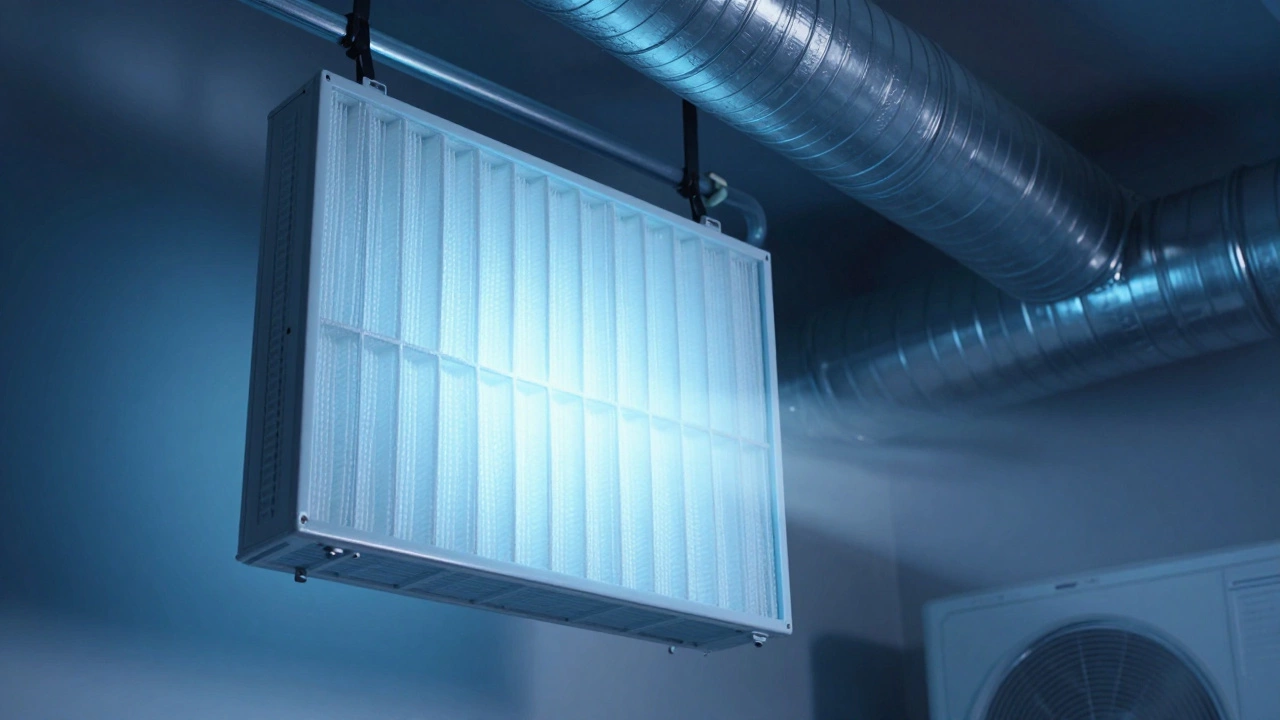
If you’re thinking about upgrading your home’s air filter to a MERV 13, you’re not alone. More people are choosing higher-rated filters to trap dust, pollen, and even smoke. But there’s a quiet worry hanging over it: Will a MERV 13 damage my AC? The short answer? Not if your system is modern and properly maintained. But if your unit is older, undersized, or already struggling, that tighter filter could cause real problems.
What Does MERV 13 Even Mean?
MERV stands for Minimum Efficiency Reporting Value. It’s a scale from 1 to 20 that tells you how well a filter catches tiny particles. A MERV 13 filter can trap particles as small as 0.3 to 1.0 microns-think mold spores, bacteria, and fine dust. That’s the same level used in hospitals and labs. It’s great for air quality, but it’s also denser than the standard MERV 8 filter most homes use.That density is the problem. Thicker fibers mean more resistance to airflow. Your AC’s blower motor has to work harder to push air through it. If your system wasn’t designed for that, it can lead to overheating, reduced cooling, or even motor burnout over time.
How Airflow Works in Your AC System
Your air conditioner doesn’t just blow cold air-it pulls air in from your home, cools it, and pushes it back out. That whole cycle depends on consistent airflow. If the filter blocks too much air, the system can’t move enough air over the evaporator coil. That coil starts to freeze up. Ice builds up, airflow drops even more, and your house stays warm while your energy bill climbs.Think of it like breathing through a straw. At first, it’s fine. But if you keep it up for hours, your lungs get tired. Your AC motor is the same. It’s built to handle a certain amount of resistance. A MERV 13 filter can push it past its limit.
When a MERV 13 Is Safe to Use
Not every AC system will break with a MERV 13. Many modern units are built to handle it. Here’s how to tell if yours is one of them:- Your AC is less than 10 years old
- You have a variable-speed blower motor (it runs quietly and adjusts speed)
- Your ductwork is sealed and properly sized
- Your system was professionally installed with correct airflow specs
Manufacturers like Carrier, Trane, and Lennox now design many of their newer models to work with MERV 13 filters. Check your owner’s manual or look for a label on the unit that says "Accepts MERV 13" or "Recommended Filter: MERV 11-13". If it’s there, you’re good to go.
When a MERV 13 Could Hurt Your AC
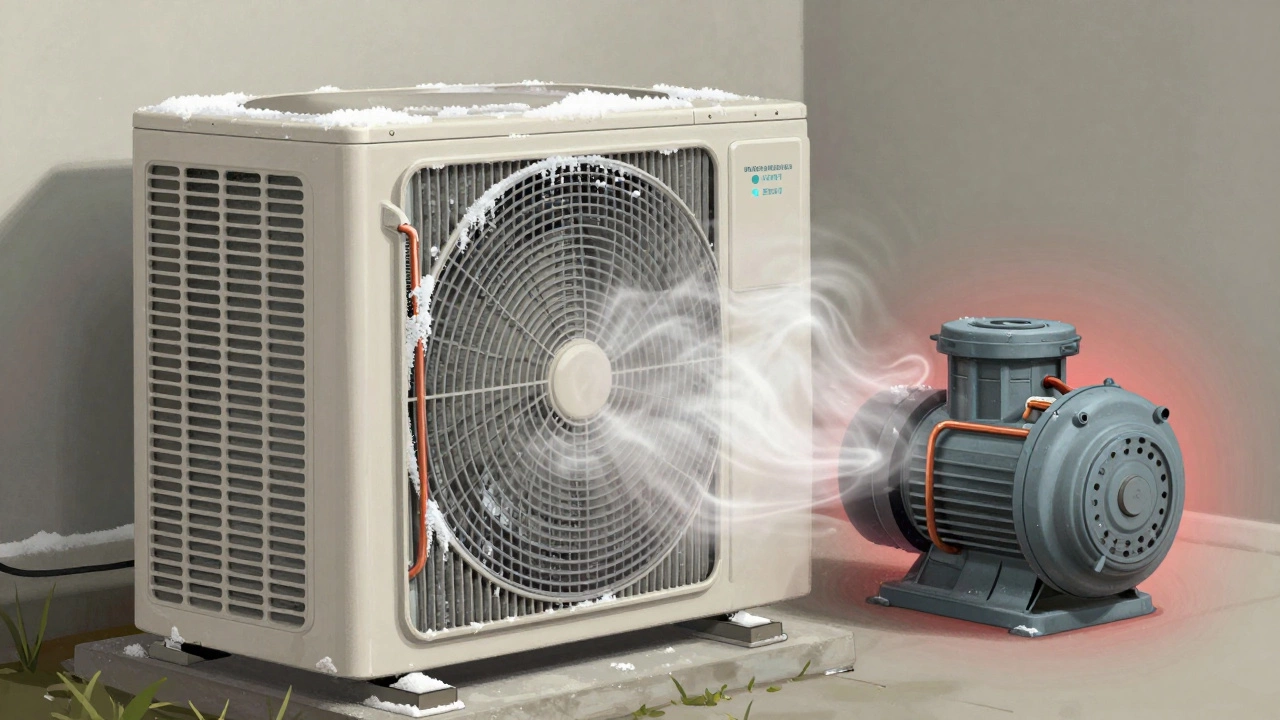
Older systems, especially those from the 90s or early 2000s, were built for MERV 6-8 filters. They have single-speed motors and smaller ducts. Here are red flags:- Your AC runs constantly, even when it’s not hot outside
- You hear a whining or straining noise from the blower
- Ice forms on the copper lines near the indoor unit
- Your utility bills spiked after switching filters
- Your home has rooms that never cool down
If any of these sound familiar, upgrading to MERV 13 is asking for trouble. The extra resistance could force your motor to overheat. In extreme cases, it can crack the heat exchanger or fry the capacitor. Replacing those parts costs more than a new filter ever will.
How to Test If Your AC Can Handle MERV 13
You don’t need a technician to find out if your system can handle it. Try this simple test:- Turn off your AC and replace your current filter with a MERV 13.
- Turn the system on and set the fan to "On" (not "Auto").
- Wait 15 minutes and check the air coming out of your vents. Is it noticeably weaker?
- Feel the air near the outdoor unit. Is it warmer than usual? That means the coil isn’t cooling properly.
- Check the filter after 24 hours. If it’s clogged with dust already, your system is struggling.
If airflow feels sluggish or the filter gets dirty fast, switch back to a MERV 8 or 11. Don’t wait for your AC to fail.
Alternatives to MERV 13
You don’t have to choose between clean air and a working AC. There are better options:- MERV 11: Catches 85% of particles under 1 micron-good enough for most homes with allergies or pets.
- Electrostatic filters: Washable filters that use static charge to trap dust without blocking airflow.
- Portable air purifiers: Use a HEPA purifier in your bedroom or living room to clean air locally without stressing your HVAC.
- UV-C lights: Installed in your ductwork, they kill mold and bacteria without affecting airflow.
Many people use a MERV 11 filter in their HVAC and a standalone HEPA purifier in high-traffic rooms. It gives you the air quality you want without overloading your system.
What Happens If You Ignore the Warning Signs?
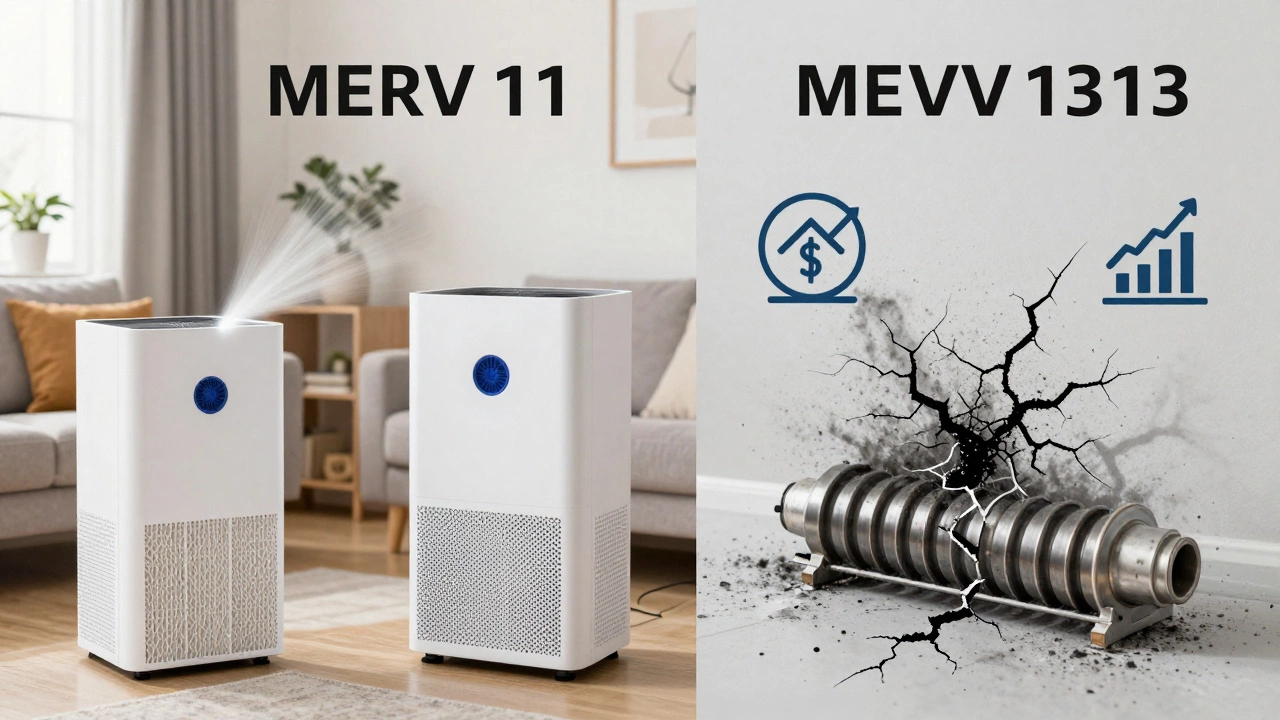
If you keep a MERV 13 in a system that can’t handle it, you’ll see symptoms over time:- Higher electricity bills (your motor runs longer and harder)
- Frequent shutdowns (the system overheats and shuts off as a safety measure)
- Condensation leaks (frozen coils melt and overflow drain pans)
- Strange smells (mold grows in damp, poorly ventilated coils)
- Complete blower motor failure (costs $800-$1,500 to replace)
One homeowner in Wellington replaced their MERV 8 with a MERV 13 to help with hay fever. Six months later, their blower motor died in winter. The repair cost $1,200. They could’ve bought a HEPA purifier for $200 and avoided the whole thing.
Prevention Is Cheaper Than Repair
The best way to avoid damage? Know your system. If you’re unsure, call a local HVAC tech for a simple airflow test. They’ll measure static pressure with a manometer-this tool tells you exactly how much resistance your filter is adding. If it’s over 0.5 inches of water column, you’re in danger zone.Even if your system can handle MERV 13, change the filter every 2-3 months. A dirty MERV 13 becomes a brick. A clean one? It’s still efficient but doesn’t choke your AC.
Final Answer: Will a MERV 13 Damage My AC?
It won’t damage your AC if your system is modern, well-maintained, and designed for it. But if your unit is older, has weak airflow, or you’ve noticed cooling issues, then yes-it can. Don’t assume higher MERV means better. It means more resistance. And your AC isn’t built to fight that battle alone.Choose MERV 13 only if you’ve confirmed your system can handle it. Otherwise, stick with MERV 11 or use a HEPA purifier. Clean air shouldn’t cost you a new motor.
Can I use a MERV 13 filter in my furnace?
Yes, if your furnace is a modern model (post-2010) with a variable-speed blower. Older furnaces with single-speed motors can struggle with MERV 13. Check your owner’s manual or have a technician test airflow pressure before switching.
Will MERV 13 help with allergies?
Yes, MERV 13 filters capture 90% of airborne allergens like pollen, pet dander, and mold spores. But if your AC can’t handle the airflow restriction, it may not circulate air well enough to make a difference. Pair it with a HEPA purifier in your bedroom for the best results.
How often should I change a MERV 13 filter?
Every 2 to 3 months, especially in homes with pets or allergies. MERV 13 traps more dust than lower-rated filters, so it clogs faster. A clogged filter is worse than no filter-it restricts airflow and strains your system.
Is MERV 13 better than HEPA?
HEPA filters capture 99.97% of particles down to 0.3 microns-better than MERV 13. But HEPA filters create too much resistance for most HVAC systems. They’re meant for standalone air purifiers, not central air. MERV 13 is the highest-rated filter safe for most home HVAC units.
Can I use a MERV 13 filter with a window AC unit?
Almost never. Window units have tiny, low-power fans designed for lightweight filters. A MERV 13 will block airflow so much that the unit will overheat and shut down. Stick with the filter that came with it or a basic MERV 6-8.




Write a comment