
DIY Spark Plug Cost & Difficulty Estimator
Enter your vehicle details to estimate how much you could save by doing it yourself versus paying a mechanic, and check if this job is right for your skill level.
Fill in the form and click Calculate to see your estimates.
Essential Toolkit Checklist
Note: Always work on a cold engine. If plugs are seized, do not force them—consider professional help to avoid head damage.
You’re driving along, and the engine starts to feel a little rough. Maybe it’s hesitating when you hit the gas, or your fuel economy has dropped without any change in your habits. The culprit is often something small: spark plugs. These tiny components are responsible for igniting the air-fuel mixture in your engine cylinders, but they wear out over time. The big question most drivers face is whether this is a job for a mechanic or a weekend project you can handle in your driveway.
The short answer? Yes, you absolutely can replace them yourself. For most modern cars, it’s one of the easiest mechanical tasks you’ll ever do. But there’s a catch. If you don’t know what you’re doing, you can strip the threads in the cylinder head, which turns a $50 job into a $1,000 repair. This guide will walk you through exactly how to swap them safely, what tools you need, and when you should probably just call a pro.
Key Takeaways
- It’s beginner-friendly: Replacing spark plugs takes about 30-60 minutes for most 4-cylinder engines.
- Tools matter: You need a specific spark plug socket (usually 5/8" or 13/16") and a torque wrench to avoid damage.
- Gapping is critical: Pre-gapped plugs aren't always perfect; check the gap with a feeler gauge before installing.
- Cold engine rule: Always work on a cold engine to prevent thread damage and burns.
- Know your limits: If your plugs are seized or your engine design is cramped (like some V6s), consider professional help.
Why Should You Change Your Own Spark Plugs?
Let’s talk money first. At a typical independent shop, replacing spark plugs costs between $150 and $300 depending on the vehicle. That price includes labor, which is often higher than the parts themselves. If you buy a set of high-quality NGK or Bosch plugs online, you might spend $40 to $80 total. Doing it yourself saves you that labor markup instantly.
Beyond savings, there’s the satisfaction factor. There’s a real sense of accomplishment in hearing your engine idle smoothly after you’ve fixed it with your own hands. Plus, you learn your car better. When you pull those old plugs out, you get a diagnostic report right in your hand. Are they black and sooty? You might have a rich fuel mixture. Are they white and blistered? You could be running too hot. Mechanics often skip explaining this part, but as a DIYer, you get the full picture.
However, don’t underestimate the risk of error. Modern engines rely on precise electrical resistance and heat dissipation from the plugs. Using the wrong type or tightening them incorrectly can lead to misfires, poor performance, or even catastrophic engine damage if a plug breaks off inside the cylinder head. It’s low-risk if you follow instructions, but high-reward only if you respect the process.
What Tools Do You Actually Need?
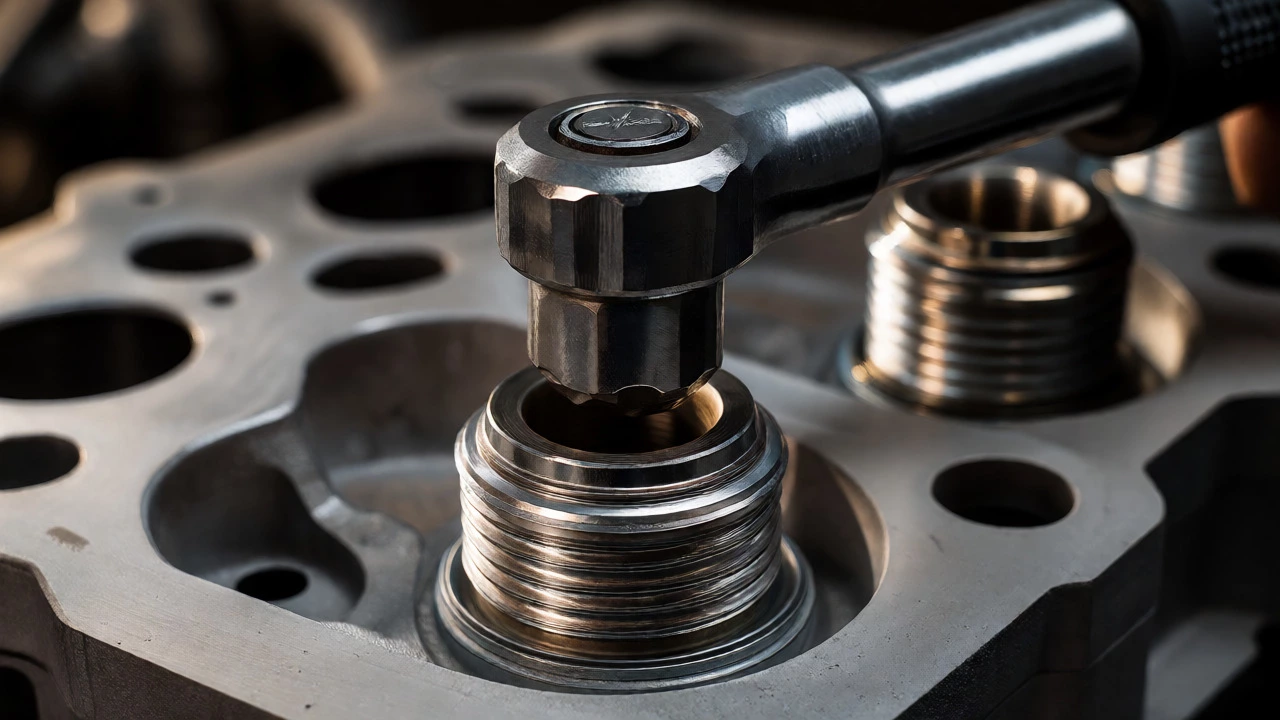
You don’t need a garage full of equipment, but you do need the right specifics. A standard ratchet won’t cut it because spark plug sockets are deep-well and often have a rubber insert to hold the plug. Here is your essential toolkit checklist:
| Tool | Why You Need It | Estimated Cost |
|---|---|---|
| Deep Well Spark Plug Socket | Fits over the ceramic insulator; usually 5/8" or 13/16". Rubber insert prevents dropping the plug. | $10 - $20 |
| Torque Wrench (In-lb) | Prevents stripping aluminum heads. Most plugs require 15-20 ft-lbs (180-240 in-lbs). | $25 - $50 |
| Feeler Gauge | Checks the electrode gap. Even "pre-gapped" plugs can shift during shipping. | $5 - $10 |
| Diamond Point File | To gently adjust the gap if it's incorrect. Never use pliers on new plugs. | $5 |
| Anti-Seize Compound | Optional. Apply sparingly to threads to prevent seizing next time. Not needed for nickel-plated plugs. | $5 |
If you don’t have a torque wrench, you can estimate tightness by hand-tightening until it seats, then turning an additional 1/16th turn for new gaskets or 1/12th for used ones. But honestly, a cheap beam-style torque wrench is worth every penny. Aluminum cylinder heads are soft. Overtightening is the number one cause of DIY spark plug disasters.
Step-by-Step: How to Replace Spark Plugs Safely
Before you start, make sure your engine is completely cold. Working on a hot engine risks burning your fingers and, more importantly, thermal expansion makes the metal softer, increasing the chance of stripping threads. Also, disconnect the negative terminal on your battery if you’re working near sensitive electronics, though many mechanics skip this for simple plug swaps. We recommend it for peace of mind.
- Locate the Ignition Coils: On older cars, you’ll see thick black wires (spark plug wires) leading to the plugs. On newer cars (post-2005 mostly), you’ll see individual coil packs sitting directly on top of each plug. Remove the plastic engine cover if necessary.
- Remove the Coil Packs: Unclip the electrical connector from each coil pack. Unscrew the bolt holding the coil down (usually a 10mm hex bit). Pull the coil straight up. Inspect the boot at the bottom of the coil-if it’s cracked or oily, replace the boot or the whole coil later.
- Clean the Area: Use compressed air to blow debris away from the hole where the plug sits. You do not want dirt falling into the cylinder.
- Remove Old Plugs: Attach your spark plug socket to a breaker bar or ratchet. Loosen the plug counter-clockwise. Once loose, remove it by hand. Lay them out in order (cylinder 1 to 4) so you can inspect them individually.
- Check the Gap: Look at your owner’s manual for the correct gap specification (e.g., 0.043"). Use your feeler gauge. If the gap is too wide, gently bend the side electrode inward with a tool. If too narrow, pry it outward. Be gentle.
- Install New Plugs: Hand-thread the new plug clockwise into the hole. This is crucial. If it doesn’t turn easily by hand, stop. You might be cross-threading it. Once seated, tighten with your socket. If using anti-seize, apply a tiny amount to the threads only (not the tip).
- Torque Them Down: Set your torque wrench to the spec (check your manual, typically 180-240 in-lbs). Tighten until the wrench clicks. Do not force it past the click.
- Reassemble: Put the coils back in, ensure they click into place, reconnect the bolts and electrical connectors. Start the engine. Listen for smooth idling.
When Should You Skip the DIY Route?
While we love a good DIY win, there are scenarios where paying a mechanic is smarter. First, consider your engine layout. Some transverse-mounted V6 engines, like those in certain Honda Accords or Nissan Altimas, have rear bank plugs buried under the intake manifold. Accessing them might require removing multiple hoses, brackets, and potentially the throttle body. If you’ve never removed an intake manifold before, that’s a steep learning curve for a routine maintenance item.
Second, look at the condition of the old plugs. If you try to loosen a plug and it feels stuck, do not force it. Seized plugs happen when corrosion bonds the steel plug to the aluminum head. Forcing it can snap the plug off, leaving the threaded portion inside the cylinder head. Extracting a broken spark plug requires specialized extractors and sometimes drilling, which is a nightmare for beginners. If a plug resists removal, soak it with penetrating oil like PB Blaster and let it sit for hours, or take it to a pro who has impact guns and experience handling seized hardware.
Finally, if your car uses iridium or platinum plugs with very long service intervals (over 100,000 miles), the plugs may be heavily carbon-fouled or welded by heat. In these cases, the risk of breakage increases significantly. If you’re uncomfortable with the possibility of needing to fish a broken piece out of your engine, save the hassle and pay for the service.

Understanding Spark Plug Types and Lifespan
Not all plugs are created equal. Choosing the right one affects both performance and longevity. Your owner’s manual specifies the exact part number, but understanding the materials helps you shop wisely.
| Type | Lifespan (Miles) | Cost Per Plug | Best For |
|---|---|---|---|
| Copper Core | 20,000 - 30,000 | $2 - $5 | Older vehicles, turbocharged engines needing frequent changes. |
| Premium Copper | 30,000 - 40,000 | $4 - $7 | Standard daily drivers with moderate mileage. |
| Platinum | 50,000 - 60,000 | $8 - $12 | Modern vehicles requiring consistent performance. |
| Iridium | 60,000 - 100,000+ | $10 - $20 | High-performance engines, long-service-interval cars. |
Most cars built after 2010 use iridium or platinum plugs. Don’t downgrade to copper unless you plan to change them frequently. While copper conducts electricity better initially, it wears faster. Upgrading to iridium when your manual calls for platinum is usually fine, but downgrading can cause issues with your engine control unit (ECU) expecting a specific heat range.
Common Mistakes to Avoid
We’ve seen plenty of DIYers stumble on these three points. First, dropping the plug. If you drop a spark plug from just two feet onto concrete, the internal ceramic insulator can crack invisibly. It might still fire, but it will fail prematurely. Always handle new plugs carefully. Second, overtightening. Remember the torque wrench. If you don’t have one, use the "finger tight plus quarter turn" method, but err on the side of less rather than more. Third, ignoring the coil boots. When you pull the coil pack off, check the rubber boot. If it’s hard, cracked, or covered in oil, replace it. A bad boot causes arcing, which looks like a misfire but isn’t caused by the plug itself.
Also, don’t mix brands unnecessarily. If your car came with NGK, stick with NGK. Mixing Denso and Bosch can sometimes lead to slight variations in heat range or reach length, causing uneven combustion. Consistency across all cylinders is key for smooth operation.
Final Thoughts on DIY Maintenance
Replacing spark plugs is a gateway drug to other car repairs. Once you realize how easy it is to access the top end of your engine, you’ll feel more confident tackling valve cover gaskets or PCV valves. It’s a low-cost experiment with high educational value. Just remember: preparation beats speed. Read your manual, buy the right tools, and take your time. If you hear that smooth, steady idle after you button everything up, you’ll wonder why you ever paid someone else to do it.
How long does it take to replace spark plugs?
For a standard 4-cylinder engine, expect to spend 30 to 45 minutes if you have the right tools. For V6 or V8 engines, especially those with difficult access, it can take 1.5 to 3 hours. The first time you do it, add extra time for reading manuals and double-checking connections.
Do I need to gap new spark plugs?
Most premium plugs come pre-gapped, but manufacturing tolerances mean they can shift during shipping. It is best practice to verify the gap with a feeler gauge against your vehicle's specification before installation. Adjusting the gap slightly is safe if done carefully with the right tool.
What happens if I overtighten a spark plug?
Overtightening can strip the threads in the aluminum cylinder head, crack the ceramic insulator, or distort the metal shell. Stripped threads often require a helicoil repair or head replacement, which is expensive. Always use a torque wrench to ensure proper clamping force without damaging the head.
Can I drive with a bad spark plug?
You can drive short distances, but a bad plug causes misfires. This means unburned fuel enters the exhaust system, which can overheat and destroy your catalytic converter. Repairing a catalytic converter costs significantly more than replacing spark plugs, so fix misfires promptly.
Should I use anti-seize on spark plugs?
Many manufacturers, including NGK and Autolite, advise against using anti-seize on modern nickel-plated plugs because it can alter the torque reading and cause overtightening. If you use it, apply a very thin coat only to the threads and reduce your torque setting by about 10%. Check your specific plug manufacturer's recommendation.







Write a comment